
Casual Outdoor Smoke vs Lounge Cigar Experience: Where Backwoods Fits
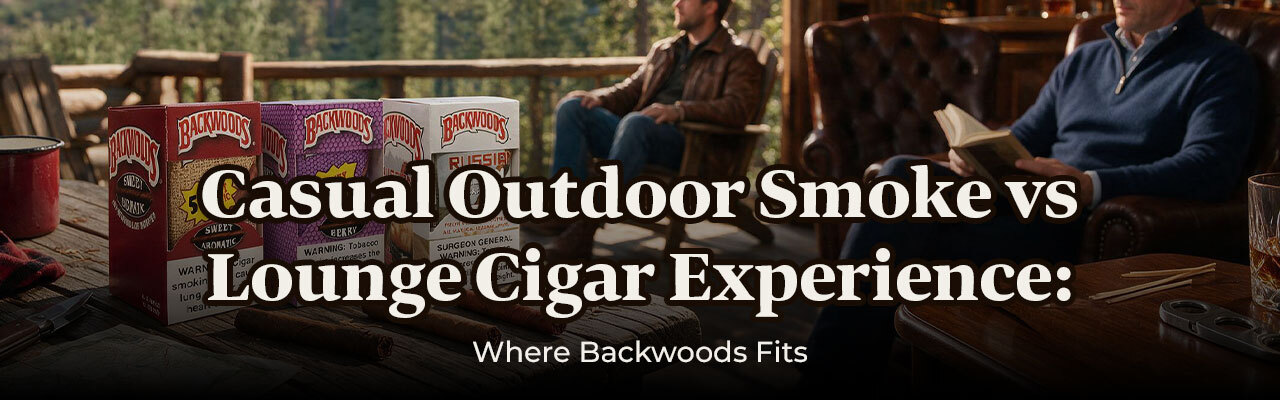
One of the reasons Backwoods Cigars are so popular is their ability to fit naturally into outdoor adventures, backyard gatherings, and casual moments of relaxation. However, where you smoke can have a noticeable impact on your experience. A Backwoods enjoyed around a campfire, on a fishing trip, or during a hike may burn and taste differently than one smoked on a calm porch or in a comfortable indoor lounge. Factors like wind, humidity, and temperature all influence how the cigar performs.
Many smokers are surprised by how much the environment affects Backwoods Cigars. Outdoor conditions can create uneven burns, faster combustion, or subtle changes in flavor, while indoor settings often provide a steadier, more consistent smoking experience. Understanding these differences helps you choose the right cigar for the occasion and get the most enjoyment from every smoke, wherever you decide to light up.
In this guide, we'll compare smoking Backwoods Cigars outdoors and indoors, explain how different environments influence their burn and flavor, and share practical tips for improving your smoking experience in any setting. By the end, you'll know when Backwoods truly shine outdoors, when an indoor session offers advantages, and how to enjoy a consistently satisfying smoke in either environment.
Key Takeaways
- Understand how tobacco reacts to its surroundings to prevent uneven burns and flavor loss in different conditions.
- Learn why a controlled lounge environment is ideal for complex premium cigars while sturdier, robust sticks perform better when smoking outdoors.
- Master the technical side of the cigar lifestyle by choosing the right lighter and storage method for your specific environment.
- Evaluate your options through a detailed outdoor cigar vs lounge cigar comparison to ensure you never waste a high-quality smoke in the wrong setting.
- Discover where casual smokes like Backwoods Honey Berry fit into your rotation compared to sophisticated choices like the Arturo Fuente Hemingway.
The Environmental Factor: Why Where You Smoke Matters
Tobacco is a biological, hygroscopic material that continuously seeks moisture equilibrium with its surrounding environment. Because tobacco leaf readily absorbs or desorbs ambient water vapor, your smoking environment serves as the single most influential factor shaping combustion, airflow, and flavor delivery. Whether you are seated in a climate-controlled room or standing on a breezy outdoor deck, the surrounding atmosphere directly alters the underlying chemistry of your smoke.
Tobacco Moisture Content Equilibrium Metrics
To perform as intended, premium cigar leaves require a precise internal balance between water content and natural essential oils:
- Target Equilibrium (12% to 14% Moisture Content): Master blenders design cigars to be smoked when the internal leaf reaches a quantitative Moisture Content (MC) of 12% to 14%. At this optimal level, the leaf remains pliable, burns at a controlled speed, and cleanly vaporizes natural oils.
- Dehydration Deficit (<10% Moisture Content): When exposed to dry ambient air, internal moisture quickly drops below 10% MC. This rapid drying causes volatile aromatic oils to evaporate into the air before you even light up. The result is a fast, scorching burn that tastes dry, papery, and devoid of nuance.
- Over-Saturation (>16% Moisture Content): Conversely, exposure to high humidity pushes internal leaf moisture above 16% MC. Excess water creates combustion resistance, leading to incomplete combustion, frequent relights, heavy draw resistance, and the release of sharp, bitter residual ammonia that should have evaporated during curing.
Pyrolysis and Combustion Temperature Physics
Temperature and airflow govern the thermal physics of the cigar's ember (or "cherry"). During a steady, measured draw in still air, the burning core maintains an ideal combustion temperature between 1,400°F and 1,600°F.
- Ideal Pyrolysis (1,400°F–1,600°F): Within this precise thermal window, heat gently pyrolyzes natural tobacco compounds, releasing delicate, low-boiling-point terpenes, light aromatic oils, and pleasant wood or floral notes.
- Excessive Heat (>1,600°F): When outdoor heat, low humidity, or rapid puffing spikes the ember temperature past 1,600°F, delicate light terpenes are instantly destroyed by thermal degradation. Instead of smooth flavor, excessive heat drives severe thermal cracking of plant matter, producing heavy, acrid pyrolytic byproducts—specifically dense tar and carbon buildup—that coat the palate in a harsh, astringent, and charred aftertaste.
Oxygen Flow: The Wind Bellows Effect
Consistency is the foundational advantage of a climate-controlled lounge. Still indoor air provides a stable, predictable oxygen supply that allows the combustion front to advance evenly across the wrapper, binder, and filler.
Smoking outdoors introduces erratic wind currents, which act like a mechanical bellows forced against the ember. Gusts force excess oxygen directly into the foot, accelerating the combustion rate far beyond its natural pace. Uncontrolled oxygen spikes elevate the cherry temperature into the destructive pyrolytic range, ruining complex long-filler blends like the Montecristo White Series or Oliva Serie V before the flavor profile can naturally unfold.
Cigar Lounge Culture: The Controlled Smoking Environment
A dedicated cigar lounge serves as the primary sanctuary for tasting complex hand-rolled cigars. Unlike unpredictable outdoor settings, a lounge provides a "still air" microclimate that eliminates environmental turbulence. Master blenders construct premium long-filler blends with the assumption that they will be burned in a stable atmosphere where delicate flavor transitions can unfold without wind forcing an accelerated combustion rate.
HVAC and Smoke Mitigation Engineering Specifications
The air quality within a world-class lounge relies on advanced environmental engineering designed to remove heavy smoke and volatile compounds without creating disruptive drafts:
- Air Exchange Rates (12 to 15 ACH): Commercial lounge ventilation systems operate at 12 to 15 Air Changes per Hour (ACH). This continuous circulation continuously exhausts stale air and replaces it with fresh, temperature- and humidity-controlled intake air.
- HEPA Particulate Filtration: Mechanical HEPA (High-Efficiency Particulate Air) filters capture airborne particulates, ash micro-particles, and solid combustion byproducts down to 0.3 microns.
- Activated Carbon Gas-Phase Adsorption: Heavy beds of granular activated carbon adsorb gaseous Volatile Organic Compounds (VOCs), harsh phenols, and ammonia vapors released during combustion, keeping the room note clean and preventing stale odor accumulation.
- Non-Turbulent Airflow Architecture: Systems are engineered to move high volumes of air at low velocities using wide diffusers. This avoids sharp, localized air drafts across smoking chairs, which could otherwise act like wind currents and cause cigars to canoe or burn unevenly.
Lounge Etiquette Essentials
Proper lounge conduct reflects respect for both the craft and fellow enthusiasts. Key guidelines include:
- The "Buy One, Support the House" Rule: If utilizing a lounge's humidor, seating, and ventilation facilities, purchase a stick from their shop even if you bring a rare cigar from your personal humidor.
- Ash Management: Allow the ash to build naturally to a half-inch or inch before gently resting the foot in the ashtray. Tapping a cigar aggressively against the tray knocks off the ember cap, exposing the core to sudden oxygen blasts that spike burning temperatures.
- Purging and Directing Smoke: Blow smoke gently upward or away from neighboring guests, and never stub out a cigar like a cigarette, as crushing the foot releases bitter, burnt tar aromas into the room.
Best Cigars for the Lounge Environment
The still air of a lounge provides the ideal environment for large, complex vitolas requiring 60 to 90 minutes of focused smoking time:
- Large Vitolas (Churchill, Double Corona): These long formats allow blenders to layer different filler tobacco leaves vertically, creating distinct transitions across the first, second, and final thirds of the smoke.
- Delicate Wrapper Varieties: Thin, elastic wrappers like Connecticut Shade or delicate African Cameroon thrive in controlled indoor humidity. Lacking the thickness of sun-grown broadleaf, these fine leaves remain pristine indoors, delivering creamy, nutty, and subtle floral nuances that would otherwise be lost in open outdoor air. Classic choices like the Montecristo White Series and Romeo y Julieta Reserva Real showcase their true depth in this setting.
Smoking Outdoors: Mastering the Elements
Moving from the sanctuary of a climate-controlled lounge to an outdoor patio, deck, or golf course exposes a cigar to aggressive environmental variables. Outdoor smoking requires a tactical shift in wrapper selection, vitola choice, and lighting technique. Resilient blends featuring oily Habano or sun-grown broadleaf wrappers—such as those engineered by AJ Fernandez or Rocky Patel—deliver bold pepper, earth, and leather profiles that readily cut through open air where subtle cream notes would dissipate.
Thermal and Relative Humidity Shock
One of the most frequent structural failures outdoors is catastrophic wrapper splitting. While direct UV exposure dries out tobacco, the primary culprit behind severe leaf cracking is Thermal and Relative Humidity (RH) Shock:
- Moisture Gradient Formation: When a cigar is removed from a 70% RH humidor and immediately exposed to dry, low-humidity outdoor air or elevated ambient heat, a rapid moisture gradient develops between the outer wrapper and the internal filler core.
- Volumetric Expansion vs. Contraction: The thin outer wrapper desorbs moisture quickly, drying and shrinking tightly across the barrel. Simultaneously, ambient heat causes trapped moisture inside the thick filler leaves to expand.
- Cell Wall Rupture: As the inner filler swells while the outer wrapper rapidly contracts, the resulting physical tension exceeds the elasticity of the wrapper leaf, causing cell wall rupture and causing the wrapper to split violently down the seams.
To mitigate RH shock, store cigars in a sealed travel humidor with two-way humidity control until the exact moment of lighting, allowing the tobacco to acclimate gradually.
The Wind Factor and Burn Correction
Wind serves as an uncontrolled forced-oxygen mechanism, drastically accelerating combustion and driving ember temperatures into the harsh pyrolytic range. This targeted airflow causes canoeing (where one side burns rapidly while the other remains unlit) and runners (sharp veins of fire shooting down the barrel).
- Active Rotation: Rotate the cigar 90 degrees every few puffs so the wind hits different sides of the foot, balancing the combustion rate.
- Targeted Re-lighting: Use a high-output triple-flame torch lighter to apply direct, concentrated heat to the unburnt side of a canoe, re-establishing a flat burn line.
- Trimming a Runner: If an aggressive runner develops down one seam, use a sharp guillotine cutter to cleanly trim off the uneven foot section behind the runner, resetting the cherry to preserve the flavor profile.
Vitolas for Active Environments
In active outdoor settings, shorter and thicker vitolas outperform long, slender shapes:
- Robusto and Rothschild Formats: Compact lengths (4.5 to 5 inches) offer manageable 30- to 45-minute sessions, minimizing total exposure time to wind and UV rays.
- Thicker Ring Gauges (50 to 60+): Large-diameter vitolas provide physical resilience against mechanical stress. Furthermore, a wide surface area distributes airflow across a larger core, keeping the internal cherry cooler despite wind gusts and preventing the burn front from tunneling through the center of the stick.
Cigar Experience Comparison: Choosing by Setting
Selecting the right cigar requires matching a blend’s flavor profile and physical vitola construction to your surroundings. Environmental variables—such as wind velocity, ambient relative humidity, and air filtration—can either highlight or ruin a cigar's intended flavor profile. Aligning your cigar selection with the smoking environment maximizes your cost-to-experience ratio and prevents wasting ultra-premium tobacco in unpredictable conditions.
Flavor Resilience and Terpene Persistence
Subtle aromatic nuances—such as white tea, light floral notes, hay, and soft cream—are the first casualties of outdoor breeze. These low-boiling-point aromatic compounds require still indoor air to concentrate in the head of the cigar and reach the palate.
In outdoor settings, prioritize blends engineered with bold flavor resilience:
- Outdoor Environments: Opt for full-bodied Nicaraguan or Ligero-heavy filler blends (such as those from AJ Fernandez or Oliva Serie V). High concentrations of natural spicy terpenes, dark espresso, black pepper, and heavy leather notes readily cut through open air.
- Social & Crowd Settings: Aromatic or sweet-casing options (such as the Acid Kuba Kuba) perform exceptionally well outdoors, as their sweet room note is crowd-friendly and less reliant on still-air tasting conditions.
Combustion Dynamics of Large Ring Gauges
While slender vitolas like Lanceros (38–40 ring gauge) excel in still lounges, thick ring gauges (50 to 60+ ring gauge Gordos) provide a distinct thermal advantage outdoors:
- Expanded Thermal Heat Sink: A larger ring gauge creates a broader combustion surface area across the foot.
- Core Protection Against Wind: When wind blasts force excess oxygen into the cherry, a wide ring gauge dissipates the thermal spike across a larger volume of tobacco. This keeps the internal core temperature significantly cooler than in a thin cigar, preventing oxygen surges from scorching the central filler leaves and destroying the flavor profile.
Structural Differences: Long-Filler vs. Short-Filler Under Wind
Understanding the physical construction of hand-rolled long-filler cigars versus machine-made short-filler sticks is critical when selecting tobacco for harsh environments:
- Long-Filler Premium Cigars: Hand-rolled using full, unbroken leaves rolled lengthwise down the barrel. These continuous tobacco bundles act as structural channels, maintaining consistent draw resistance and thermal mass. Long-filler leaves resist shedding ash and burn evenly, even when exposed to ambient wind currents.
- Short-Filler Machine-Made Cigars: Constructed from chopped tobacco scrap encased in natural leaf or homogenized tobacco sheets (e.g., Dutch Masters). The air gaps between chopped scrap fragments allow wind to penetrate deep into the core. This causes short-filler sticks to combust rapidly, burn exceedingly hot, and drop loose, flaky ash. While short-filler options offer cheap, casual utility where losing a stick is of no consequence, they lack the structural thermal mass needed to preserve flavor under wind stress.
The Setting vs. Selection Framework
- Lounge Sanctuary: Delicate wrappers (Connecticut Shade), complex long-filler vitolas (Churchill, Figurado), and vintage blends (e.g., Arturo Fuente Hemingway) where 60–90 minutes of still air allow three-stage flavor transitions to unfold naturally.
- Active Outdoor / Patio: Robust, thick sun-grown or Maduro wrappers, 52–60 ring gauge Robustos or Gordos, and spice-forward Nicaraguan long-fillers built to withstand wind and humidity shifts.
Essential Gear for Every Smoking Environment
Selecting the right gear serves as the mechanical bridge between ambient environmental conditions and ideal tobacco combustion. Matching your accessories to your specific smoking setting prevents common burn defects, shields delicate wrappers from physical damage, and preserves the structural integrity of your cigars.
Lighter Mechanics and Thermal Dynamics
Choosing the right ignition source is dictated by airflow dynamics and flame temperature physics:
- Soft Flame Lighters (1,400°F to 1,700°F): Ambient soft-flame butane lighters produce a gentle, unpressurized yellow flame burning at roughly 1,400°F to 1,700°F. This lower thermal output is ideal for still indoor lounge environments. It allows you to slowly toast the foot without scorching the delicate wrapper leaf, preserving light volatile terpenes during the initial light.
- Jet-Torch Lighters (2,300°F to 2,500°F): Jet torches force oxygen-pressurized butane through micro-jets, producing pinpoint blue flames that burn at 2,300°F to 2,500°F. This high thermal intensity and velocity make torch lighters completely wind-resistant, providing the high heat necessary to quickly ignite thick, oily broadleaf wrappers outdoors without the flame deflecting in a breeze.
Precision Cutters for Airflow Control
Your choice of cutter impacts draw dynamics and airflow resistance based on vitola size:
- V-Cutters (Deep Wedge Cut): Ideal for large ring gauges (50 to 60+) often smoked outdoors. The deep notch creates a continuous, high-surface-area wedge without removing the entire cap, maximizing airflow while maintaining structural cap stability in windy conditions.
- Straight Guillotine Cutters: Provide a clean, flat cut that exposes the entire filler cross-section, allowing for even draw distribution across delicate indoor vitolas.
Travel Storage and Two-Way Relative Humidity Control
Transporting cigars outside a climate-controlled room exposes them to ambient temperature fluctuations and physical vibration. Relying on makeshift bags or uncalibrated sponges can ruin premium cigars within hours:
- Hermetic Travel Cases: Heavy-duty, O-ring sealed travel humidors protect sticks from physical crushing while creating an airtight micro-seal that isolates the tobacco from sudden outdoor humidity drops.
- Two-Way RH Control Technology: Because airtight travel cases lack natural air exchange, traditional wet floral sponges emit uncalibrated water vapor that spikes internal relative humidity past 75%—leading to soggy foot swelling and mold risk. Travel cases require two-way humidity control packets (such as 65% or 69% Boveda packs utilizing reverse-osmosis salt-water membranes). These two-way membranes dynamically release pure water vapor when ambient RH drops and absorb excess moisture when RH spikes, maintaining a locked equilibrium that shields cigars from Thermal and RH Shock during transit.
Elevate Your Next Session with Expert Selection
Success in the cigar hobby requires more than just picking a well-reviewed blend; it demands an understanding of how ambient temperature, humidity, and airflow dictate tobacco combustion. Matching robust vitolas and oily wrappers to windy outdoor conditions prevents frustrating burn defects, while reserving delicate, multi-layered long-fillers for the still air of a lounge allows intricate flavor transitions to shine.
To put these principles into practice, utilize these three tactical frameworks to prepare your inventory, equipment, and environment for any smoking session.
Tactical Frameworks for the Modern Enthusiast
1. Outdoor Vitola & Wind-Speed Matrix
Use this guide to match vitola construction and leaf choice directly to environmental wind conditions:
| Wind Level | Air Speed | Recommended Vitola & Ring Gauge | Ideal Leaf & Wrapper Types | Combustion Advantage |
|---|---|---|---|---|
| Calm / Still Air | 0 – 3 mph | Lancero, Lonsdale, Churchill (38–48 RG) | Connecticut Shade, Ecuador Connecticut, Cameroon | Low heat output preserves delicate volatile terpenes and cream/floral notes without scorching thin leaves. |
| Moderate Breeze | 4 – 12 mph | Robusto, Toro (50–54 RG) | Habano, Sun-Grown Sumatra, Corojo | Medium ring gauge provides structural stability; oily sun-grown leaves resist minor wind flares. |
| High Gusts | 13+ mph | Gordo, Rothschild (56–60+ RG) | Connecticut Broadleaf, San Andrés Maduro | Massive surface area acts as a heat sink, keeping the core cherry cool and preventing oxygen blasts from tunneling. |
2. Travel Humidor Preparation Checklist
Follow these steps prior to outdoor excursions or travel to prevent Thermal and Relative Humidity Shock:
- [ ] Seal Integrity Test: Inspect the travel humidor's rubber O-ring seal to ensure an airtight, dustproof compression fit.
- [ ] Two-Way RH Calibration: Insert fresh 65% or 69% two-way humidity control packets (such as Boveda) at least 24 hours before loading cigars. Avoid wet sponges, which cause foot swelling and mold risk.
- [ ] Acclimation Window: Place cigars into the travel case 12 to 24 hours prior to departure so internal leaf moisture stabilizes at equilibrium before facing ambient temperature shifts.
- [ ] Gear Maintenance: Bleed residual air from your jet-torch lighter before refilling with high-purity butane, ensuring reliable ignition in windy settings.
3. Cigar Lounge Selection Protocol
When choosing a new lounge or evaluating a dedicated smoking room, look for these three benchmarks of a high-performing environment:
- Air Quality & Circulation: Confirm the lounge utilizes an active commercial HVAC system offering 12 to 15 Air Changes per Hour (ACH) with integrated HEPA and activated carbon filtration. Air should feel fresh and non-turbulent, without heavy smoke clouds hanging at shoulder level.
- Proper Storage Calibration: Check the lounge humidor's hygrometer. Inventory should be maintained consistently between 65%–70% Relative Humidity and 65°F–70°F.
- Etiquette Compliance: Respect the "buy-one, smoke-one" standard, support local lounge humidors, and match your vitola selection to the time you have available (e.g., reserving Churchills and Double Coronas for 75+ minute sessions).
Find Your Next Smoke at Gotham Cigars
Whether you are building a rugged outdoor travel kit or selecting nuanced vintage blends for a lounge evening, Gotham Cigars supports your journey with over 20 years of industry expertise. Every cigar in our expansive inventory is stored in a climate-controlled warehouse to ensure it arrives fresh, perfectly hydrated, and ready to spark.
Explore our curated samplers, top-rated brands like Acid and Arturo Fuente, or join the Gotham Cigars Cigar of the Month Club to systematically expand your palate across every smoking environment.
Frequently Asked Questions
Does wind really change the taste of a cigar?
Yes, wind accelerates combustion, causing the tobacco to burn hotter and turning subtle flavors bitter. The increased oxygen flow forces the cherry to burn faster than intended, which can scorch the essential oils. This shift in the combustion rate often masks nuanced profiles and replaces them with a charred, harsh aftertaste that ruins the intended experience.
Can I smoke a premium cigar in a public park?
Smoking regulations vary significantly by city and state, so you must check local ordinances before lighting up. While many parks are now smoke-free zones, others allow it in designated areas. If permitted, choose a spot downwind from others to respect the shared space and maintain a respectful presence while enjoying your smoke.
Is it rude to bring my own cigars to a cigar lounge?
It's generally considered poor etiquette to bring your own sticks without purchasing from the lounge's humidor during your visit. Most establishments operate on a "buy one, smoke one" policy to cover their overhead and service costs. If you have a rare vintage you want to smoke, ask the staff about a "cutting fee" or simply buy a few sticks to take home later.
What is the best cigar for a beginner to smoke outdoors?
A Robusto with a medium-bodied profile and a sturdier wrapper, such as an Oliva Serie V, is an excellent choice for beginners. The shorter length and 50-ring gauge provide a stable burn that is easier to manage in a light breeze. This vitola offers enough flavor to be satisfying without being so delicate that the environment ruins the experience.
How do I stop my cigar from burning unevenly in the wind?
Frequent rotation is the most effective way to prevent uneven burns like "canoeing." Turn the cigar 90 degrees every few puffs so the wind hits all sides of the foot equally. If a runner starts to develop, use a torch lighter to carefully touch up the unburnt side or use a cutter to reset the burn line entirely.
Why do cigars taste more bitter when I smoke them fast outside?
Smoking too quickly causes the cherry to overheat, which chemically alters the tobacco's oils and releases bitter compounds. When you're in challenging Cigar Smoking Environments, you might instinctively puff more often to keep the cigar lit against the wind. This creates a cycle of high heat that destroys the natural sweetness and complexity of the blend.
How long should I wait to smoke a cigar after it has been delivered?
You should ideally let your cigars rest in a calibrated humidor for 7 to 14 days after delivery. Shipping involves temperature and humidity fluctuations that can stress the tobacco. While Gotham Cigars uses a climate-controlled warehouse to ensure freshness, this stabilization period allows the leaves to reach the perfect equilibrium for an optimal outdoor cigar vs lounge cigar experience.
Continue Reading:
- The Backwoods Experience: Rustic Style, Outdoor Culture, and Casual Smoking
- Why Backwoods Cigars Look Different From Traditional Cigars
- Backwoods and Outdoor Smoking Culture: Travel, Camping, and Social Moments
- Casual vs Formal Smoking: Where Backwoods Fits in the Cigar World
- Understanding the Rough-Cut Format and Natural Leaf Style
- Quick Break vs Long Session: How Backwoods Fits Different Smoking Moments
- Pairing a Rustic Cigar With Coffee, Beer, or Outdoor Settings
- Do Rustic-Style Cigars Need a Humidor? What to Know
- The Story Behind Backwoods and Its Outdoor Identity
- Backwoods vs Traditional Cigars: What Makes the Smoking Experience Different
- Rough-Cut vs Smooth-Wrapped Cigars: Understanding the Backwoods Style
- Quick Break vs Long Session: Choosing the Right Rustic Cigar Moment
- Natural Leaf Appearance vs Traditional Uniform Cigars: What Changes in the Feel
- Backwoods FAQ: Expectations, Storage, and First Impressions
Recent Posts
-
Holiday Gift Guide for Cigar Lovers: Gifts for Every Type of Enthusiast
Finding the right holiday gift for a cigar lover doesn't have to mean choosing the most expensive b …13th Nov 2026 -
Cigar Review | Avo Cigars No.2 Cigar is One of the Best
I'm not a cigar expert, but I know when I get my hands on something good, and this weekend I defini …11th Nov 2026 -
Top Five Avo Cigars and a History of Avo
"I have always loved beautiful music. Then I found the cigar. A good cigar is like music. Now I hav …6th Nov 2026