
Natural Leaf Appearance vs Traditional Uniform Cigars: What Changes in the Feel
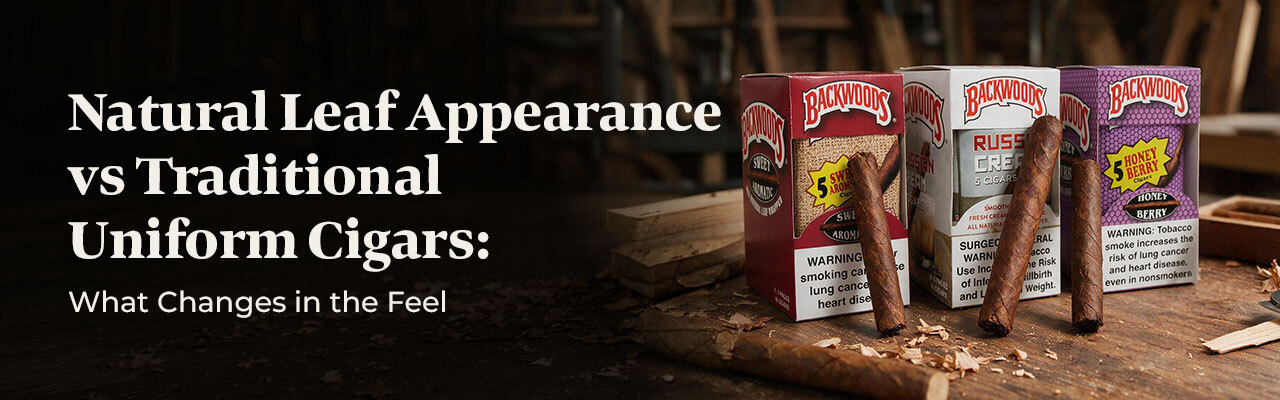
One of the first things you'll notice about Backwoods Cigars is their rough, rustic appearance. Unlike traditional cigars with smooth, polished wrappers, Backwoods feature a genuine natural leaf wrapper that gives each cigar its distinctive look and character. While some smokers mistake the veiny texture and uneven finish for poor quality, these features are actually part of what makes Backwoods unique and contribute to their signature smoking experience.
If you've ever wondered why Backwoods Cigars look so different from many other cigars on the shelf, the answer lies in the wrapper. A natural tobacco leaf offers a different appearance, flavor, and burn compared to homogenized tobacco wrappers commonly found on many machine-made cigars. Understanding these differences can help you make more informed choices and appreciate why Backwoods have remained a popular option for smokers seeking a more authentic, rustic style.
In this guide, we'll compare the natural leaf wrapper used on Backwoods Cigars with traditional cigar wrappers, explain how each affects flavor, burn, and overall performance, and help you decide which style best fits your smoking preferences. By the end, you'll have a better understanding of what sets Backwoods apart and why their rugged appearance is one of their greatest strengths.
Key Takeaways
- Identify visual and tactile differences between the rustic, whole tobacco leaf used in natural leaf cigars and the refined, uniform finish of traditional premium sticks.
- Learn how cigar wrappers and the tobacco leaf wrapper dictate flavor, with this cigar comparison of natural leaf cigars vs trad styles helping you identify your ideal profile.
- Differentiate between hand-rolled vs machine-made construction to understand why long-filler tobacco offers a more complex and consistent smoking experience.
- Choose the right stick for every occasion, from the portable convenience of rustic cigars to the ritualistic preparation of traditional cigars.
- Master your cigar lifestyle by discovering how professional climate-controlled storage maintains the freshness and integrity of your premium cigars.
Defining Natural Leaf and Traditional Cigars
The distinction between a rugged natural leaf cigar and a polished traditional stick is obvious the moment you inspect one. While both styles utilize a genuine tobacco wrapper to deliver core flavor, their internal architecture, pliability chemistry, and intended experience differ fundamentally.
What Qualifies as a Natural Leaf Cigar?
In the retail market, "Natural Leaf" represents a category defined by an unrefined, organic aesthetic. Unlike budget cigars that use Homogenized Tobacco Leaf (HTL)—a paper-like material made from reconstituted tobacco pulp—natural leaf cigars feature an intact, whole tobacco leaf as their outermost layer. This results in a rustic appearance marked by prominent veins, rough edges, and uneven shapes.
However, evaluating a natural leaf cigar requires looking beneath the wrapper:
- Filler Disparity: Mass-market natural leaf cigars (such as Backwoods Honey Berry or Game Natural Leaf) wrap a natural leaf around a core of short-filler (chopped tobacco) or pipe tobacco blends. They lack the continuous, whole-leaf filler structure found in traditional smokes.
- Chemical Pliability vs. Pure Fermentation: Mass-market natural leaf cigars remain soft and pliable inside foil pouches without a humidor because they are treated with food-grade humectants (such as propylene glycol) and flavor casings. While convenient for outdoor activities, these chemical additives alter combustion temperature and burn chemistry compared to unadulterated leaf.
The Standard for Traditional Premium Cigars
To qualify as a traditional premium cigar, a stick must meet rigorous construction standards established by historical artisan methods and reaffirmed by U.S. federal court rulings. A traditional premium cigar must satisfy five strict criteria:
- Whole-Leaf Wrapper: Wrapped in 100% whole tobacco leaf harvested, cured, and fermented as a complete unit.
- Natural Binder: Uses a 100% leaf tobacco binder to maintain structural tension and a uniform shape.
- Long-Filler Core: Contains a core made predominantly (at least 50% or more) of whole long-filler leaves running the entire length of the stick.
- Hand-Rolled Construction: Assembled 100% by hand by skilled artisans (torcedores).
- Pure Tobacco Composition: Contains zero artificial flavorings, chemical humectants, or non-tobacco additives.
A traditional masterpiece like the Arturo Fuente Hemingway relies entirely on natural water-based fermentation and precise humidity storage (65% to 70% RH) to maintain wrapper elasticity. The binder and long-filler work together to provide a slow, cooler burn where complex flavor transitions occur naturally across every third of the smoke.
The Hybrid Category: Hand-Rolled "Rustic" Premiums
"Rustic" does not automatically mean machine-made or cheap. A distinct hybrid category exists within the premium world: Hand-Rolled Rustic Cigars.
Options like Cuban farm rolls, boutique Chinchalle (small factory) smokes, or unpolished factory releases (such as the Liga Privada Nasty Fritas) utilize high-grade long-filler or mixed-filler tobacco rolled entirely by hand. However, they deliberately skip aesthetic sorting, cap polishing, or foot trimming. These premium rustic sticks deliver the complex, unadulterated flavor evolution of a traditional smoke while retaining a wild, unrefined aesthetic—all without relying on chemical humectants.
Cigar Wrappers: Tobacco Leaf vs. Homogenized Materials
The wrapper leaf is the most visually distinct and flavor-critical exterior component of a cigar. However, its exact contribution to the total flavor profile depends heavily on the physical dimensions of the vitola:
- Small Ring Gauges (38–44 RG): In thin cigars like a Lancero or Petit Corona, the wrapper accounts for 70% to 80% of the total flavor output because the volume of internal filler is minimal.
- Large Ring Gauges (56–60+ RG): In thick cigars like a Gordo or Gigante, the heavy mass of filler tobacco dominates the draw, reducing the wrapper’s overall flavor contribution to roughly 20% to 30%.
Understanding whether a wrapper is made from whole natural leaf or reconstituted materials reveals fundamental differences in quality, combustion physics, and flavor delivery.
Natural Leaf vs. Homogenized Tobacco Leaf (HTL) Mechanics
Traditional premium cigars rely exclusively on whole tobacco leaves that have been harvested, cured, and fermented as complete units. Mass-market machine-made cigars, by contrast, frequently utilize Homogenized Tobacco Leaf (HTL). HTL is produced by pulverizing scrap tobacco into a fine powder and combining it with cellulose binders and water to form a uniform, paper-like sheet.
The structural difference creates completely different combustion mechanics:
- Natural Whole Leaf: Rich in natural essential oils. It burns at a controlled, lower temperature, yielding a dense, sturdy ash and allowing complex, oil-driven flavor transitions to develop as the fire progresses.
- HTL Materials: Incorporate paper pulp and chemical combustion aids. HTL burns significantly hotter and faster than natural leaf, producing a flaky, dark gray ash and delivering a flat, linear flavor profile devoid of natural evolution.
Leaf Primings: How Plant Position Dictates Wrapper Quality
A tobacco plant is harvested in stages called "primings," moving from the bottom of the stalk to the top. The position of the leaf dictates its thickness, oil content, and burn characteristics:
- Volado (Bottom Leaves): Receives the least sunlight. These leaves are thin and mild in flavor, but possess high natural combustibility.
- Seco (Middle Leaves): Receives moderate sunlight. Offers a balanced blend of aromatic flavor, medium body, and reliable burn properties.
- Ligero / Corona (Top Leaves): Receives maximum sun exposure. These top primings yield thick, coarse, oil-heavy leaves packed with high nicotine and bold spice. Dark, rich Maduro wrappers—such as those featured on many AJ Fernandez blends—often derive from thick, heavily fermented top-priming leaves like Connecticut Broadleaf or San Andrés Negro.
Identifying Quality in a Natural Wrapper Leaf
During the production of traditional premium cigars, leaves undergo meticulous sorting by color, texture, and size to ensure consistency across a box. Look for these visual and tactile markers of a high-grade natural leaf:
- Oiliness: A natural, reflective sheen indicating the leaf’s essential oils were preserved through proper fermentation and stored at ideal relative humidity (65–70% RH).
- Toothiness: Microscopic, textured bumps across the leaf surface that hold concentrated pockets of flavor-rich oils.
- Color Uniformity & Origin: Premium traditional sticks are sorted to match hues precisely—whether it is a golden-tan Ecuadorian Connecticut, a spicy Ecuadorian Sumatra, or a dark, toothy Connecticut Broadleaf.
While rustic machine-mades skip aesthetic leaf sorting to minimize production costs, traditional hand-rolled cigars treat the wrapper as an artisan showcase. Exploring curated offerings like the Gotham Cigars Cigar of the Month Club provides a direct way to sample and compare these diverse, whole-leaf wrapper origins side by side.
Hand-Rolled vs. Machine-Made Construction
The internal architecture of a cigar dictates its physical feel, draw resistance, and combustion dynamics. While the outer wrapper leaf delivers initial aromatic and flavor notes, the internal filler structure determines burn temperature, structural integrity, and how smoke travels to your palate.
The Craftsmanship of Traditional Hand-Rolling
Traditional premium cigars are assembled entirely by hand by a master roller (torcedor). To qualify legally as a premium cigar in the U.S., a stick must contain at least 50% long-filler tobacco—whole leaves that run the entire length of the cigar.
Master rollers employ specialized bunching techniques to ensure optimal airflow:
- Entubado Bunching: Each long-filler leaf is rolled into an individual, straw-like cylinder. These tubes are bunched together to create straight, unobstructed air channels from foot to head.
- Accordion Bunching: Leaves are folded back and forth like accordion bellows, creating an even density distribution that prevents tight draw spots or plugs.
Cap and Head Construction
Hand-rolled cigars require a finished head to keep the wrapper and binder under tension. Artisans apply a hand-cut piece of wrapper leaf—known as a single, double, or triple cap—using a tiny dab of odorless, tasteless natural vegetable glue. A traditional triple cap secures the head cleanly, requiring the smoker to use a guillotine, V-cutter, or punch tool. This hand-applied cap prevents the wrapper leaf from unraveling when cut.
The Middle Ground: Mixed-Filler ("Cuban Sandwich") Construction
The cigar market is not a strict binary between 100% hand-rolled long-fillers and machine-made short-fillers. A significant middle category exists: Mixed-Filler (or "Cuban Sandwich") Cigars.
- Construction Mechanics: These cigars combine high-grade long-filler trimmings (chopped leaf remnants left over from rolling premium long-filler sticks) with a full, hand-rolled binder leaf and a natural wrapper.
- The Benefit: Mixed-filler cigars offer the natural taste and hand-assembled binder tension of a premium cigar at a fraction of the price, serving as a functional bridge between everyday machine-mades and luxury long-filler selections.
Machine-Made Construction and Thermal Density Mechanics
Machine-made natural leaf cigars utilize high-speed manufacturing to produce millions of identical units with consistent weight and draw resistance.
However, their internal structure differs fundamentally from long-filler cigars:
- Short-Filler Density Matrix: Machine-mades almost exclusively use short-filler (chopped tobacco scraps). This creates a highly porous, fragmented internal density matrix. Air flows through these tiny tobacco fragments far more rapidly than through intact leaf veins, causing machine-made cigars to burn significantly hotter and faster than long-filler bundles.
- Pre-Cut Heads: Unlike traditional hand-rolled sticks that require a cutter, machine-made natural leaf options (such as Dutch Masters or Backwoods) feature open, pre-cut, or machine-punched heads for immediate convenience.
Their sturdy construction makes machine-made natural leaf options resistant to physical damage during outdoor activities. Complying with federal labeling standards and FDA packaging regulations, these options provide an accessible, predictable entry point for everyday smokers seeking real tobacco wrapper flavor without the maintenance of a full travel humidor.
Cigar Lifestyle: Choosing Between Rustic and Refined
Choosing between a rugged natural stick and a polished traditional smoke is about aligning your selection with your environment, available time, and intended setting. While traditional cigars are engineered for the quiet ritual of a cigar lounge, rustic natural leaf smokes are built for outdoor spontaneity and convenience.
The Practicality of the Rustic Outdoor Smoke
Rustic, machine-made natural leaf cigars are designed for maximum portability and effortless lighting:
- No-Cut Convenience: Most rustic sticks feature open or pre-punched heads, eliminating the need to carry guillotine cutters, V-cutters, or punch tools on fishing trips, hikes, or golf outings.
- Forgiving Construction: Their sturdy, short-filler builds tolerate pockets and travel bags without needing delicate handling.
- Aromatic & Single-Note Profiles: Brands like Backwoods or Swisher Sweets focus on bold, linear profiles or flavored casings that remain consistent from first light to final puff.
- The Hybrid Bridge: For smokers seeking a bridge between worlds, cigars like the Acid Kuba Kuba utilize a traditional hand-rolled long-filler structure infused with over 140 botanical oils and herbs, combining artisan rolling with vibrant, unconventional flavors.
Pacing and Nicotine Delivery Dynamics
The physical build of the filler tobacco fundamentally changes how nicotine enters your system:
- Rapid Delivery (Short-Filler Natural Leaf): Because short-filler scraps burn quickly and at higher temperatures, machine-made natural leaf cigars produce a sharp, rapid spike in nicotine absorption.
- Metered Release (Long-Filler Traditional): Whole long-filler leaves burn slowly and continuously over 60 to 90+ minutes. This produces a gradual, metered nicotine release that develops systemically as the combustion line moves through different leaf primings.
Fuel and Lighting Dynamics: Protecting Natural Oils
How you light your cigar impacts flavor integrity depending on the wrapper type:
- Traditional Premium Cigars: High-grade, unflavored wrappers (like Connecticut Shade, Cameroon, or Habano) contain subtle natural oils easily tainted by fuel residue. Lighting a traditional stick requires clean-burning, odorless high-purity butane torch lighters or natural wooden cedar spills. Fluid lighters (naphtha/Zippos) or sulfur matches impart harsh chemical odors directly into the delicate leaf.
- Rustic & Flavored Natural Leaf Cigars: Because machine-made or flavored options utilize bolder casings and shorter burn cycles, they are far more forgiving. They can be lit with standard soft-flame disposable lighters or wooden matches without noticeable flavor degradation.
The Meditative Ritual of the Traditional Smoke
A traditional smoke is an intentional time commitment that rewards patience. Cutting the delicate triple cap of a Montecristo White Series or lighting the tapered foot of an Arturo Fuente Hemingway turns preparation into a focused ritual. As heat draws through long-filler leaves over 45 to 90 minutes, it unlocks evolving layers of cedar, leather, cocoa, and spice. Pairing these slow-burning sticks with aged spirits, craft beer, or dark espresso enhances the sensory experience, turning an ordinary break into a refined escape.
Explore the full range of rugged and refined options at Gotham Cigars to stock your collection for any setting.
Selecting Your Next Smoke at Gotham Cigars
Finding the ideal cigar depends on your available time, smoking environment, and personal palate. Whether you need a rugged, portable option for an outdoor activity or an aged, hand-rolled masterpiece for evening relaxation, selecting the right category ensures every session meets your expectations.
Use this decision matrix to evaluate your immediate needs:
Selection Decision Matrix
| Feature / Need | Natural Leaf (Machine-Made) | Traditional Premium (Hand-Rolled) |
|---|---|---|
| Primary Use Case | Outdoors, golf, fishing, quick breaks | Lounge smoking, formal events, relaxation |
| Cut Required? | No (pre-cut / open head) | Yes (Guillotine, V-Cut, or Punch) |
| Humidor Needed? | No (while sealed in foil) | Yes (Requires 65–70% RH) |
| Average Burn Time | 15–25 minutes | 45–90+ minutes |
Recommended Natural Leaf Favorites (and Pouch Storage Reality)
For smokers who value portability and bold, consistent flavor, machine-made natural leaf classics remain industry staples:
- Top Recommendations: Swisher Sweets Original and Backwoods Honey Berry offer dependable, punchy profiles that do not require cutters or humidors while factory-sealed.
- The Foil Pouch Caveat: While multi-cigar foil pouches lock in factory moisture for transport, once unsealed, the protective barrier is broken. Unsealed machine-made natural leaf cigars will begin drying out and losing wrapper elasticity within 3 to 5 days of room air exposure. If you do not plan to smoke the full pouch immediately, transfer the remaining sticks to a humidor or a sealed ziplock bag with a 2-way humidity pack to maintain freshness.
Top-Tier Traditional Premium Selections
If you have an hour or more to enjoy the subtle transitions of a hand-rolled long-filler cigar:
- Mellow & Creamy: The Montecristo White Series serves as an ideal entry point for traditional smokes, delivering smooth notes of cream, cedar, and light leather with structural perfection.
- Rich & Full-Bodied: For deeper complexity, selections from AJ Fernandez or Oliva showcase the pinnacle of leaf fermentation, offering dense earth, espresso, and dark cocoa profiles that evolve across three distinct thirds.
Quality Assurance and Guided Discovery
Since 2001, Gotham Cigars has operated as a trusted purveyor committed to quality assurance. Every traditional stick in our inventory is stored in a climate-controlled warehouse at precise humidity levels and shipped quickly to arrive in pristine condition.
For smokers looking to expand their knowledge without guesswork, the Gotham Cigars Cigar of the Month Club delivers a handpicked selection of world-class cigars directly to your door, allowing you to sample and compare different regions, vitolas, and wrappers side by side.
Elevate Your Smoking Experience
Mastering your next smoke starts with recognizing how tobacco leaf wrappers, internal filler architecture, and rolling techniques dictate your session. Whether you value the rugged convenience of a machine-made natural leaf or the complex evolution of a hand-rolled traditional premium, understanding these structural nuances ensures every stick matches your environment and schedule.
Quick-Reference Checklist: Matching Smoke to Session
- Environment & Tools: Do you have a guillotine cutter and butane torch on hand, or do you need an open/pre-cut head you can light on the go with a standard flame?
- Storage Constraints: Will the stick be smoked from a climate-controlled humidor (65–70% RH), or pulled from a foil pouch during a golf outing or fishing trip?
- Time Commitment: Do you have 15 to 25 minutes for a quick, linear burst of flavor, or 45 to 90+ minutes to observe evolving leaf primings?
- Palate Expectations: Are you seeking a bold, consistent single-note profile or a dynamic, multi-stage flavor transition across three thirds?
Final Rule of Thumb:
Choose Natural Leaf machine-mades when convenience, physical durability, and bold single-note flavor trump ritual. Choose Traditional Premiums when you have the time, tools, and environment to savor complex flavor transitions.
Discover Your Next Smoke at Gotham Cigars
Gotham Cigars has supported the enthusiast community for over two decades with trusted industry expertise. Every selection in our inventory is maintained in climate-controlled storage at optimal temperature and humidity levels to guarantee that your cigars arrive in peak condition.
If you are looking for a guided journey through world-class tobaccos, our top-rated Cigar of the Month Club delivers a handpicked selection of premium sticks directly to your door each month. Explore our full collection of Natural Leaf and Traditional Premium Cigars at Gotham Cigars today to refine your palate and elevate your collection.
Frequently Asked Questions
Are natural leaf cigars better than machine-made cigars?
"Better" depends entirely on your priorities regarding price, convenience, and craftsmanship. Natural leaf cigars prioritize an intact tobacco leaf wrapper for organic flavor and texture, while machine-made options focus on high-volume uniformity and speed. If you value a rugged, textured feel and real tobacco taste without the higher price tag of hand-rolled premiums, natural leaf machine-mades offer an accessible daily option.
What is the difference between long-filler and short-filler tobacco?
Long-filler consists of intact whole tobacco leaves running the entire length of the stick, providing a slow, cool burn and a complex, evolving flavor profile across three thirds. Short-filler uses chopped tobacco scraps, which allow high-speed machine processing. Long-filler is the standard for premium hand-rolled cigars like the Romeo y Julieta Reserva Real, whereas short-filler is common in budget machine-made sticks, burning faster and hotter.
Do natural leaf cigars need to be kept in a humidor?
Storage requirements depend on the stick's construction and packaging. Premium hand-rolled natural leaf cigars must always be stored in a humidor (65–70% RH) to keep the wrapper leaf elastic and prevent cracking. Machine-made natural leaf cigars (such as Backwoods Honey Berry) are sold in foil pouches containing food-grade humectants, maintaining factory freshness while sealed. However, once the pouch seal is broken, they dry out rapidly within 3 to 5 days unless transferred to a humidor or a sealed bag with a humidity pack.
Why are hand-rolled cigars more expensive than machine-made ones?
The price reflects the skilled artistry and premium raw materials involved. A master roller (torcedor) manually bunches long-filler leaves and applies a hand-cut cap to ensure optimal draw and structural integrity—a craft requiring years of apprenticeship. Conversely, high-speed machines can produce thousands of short-filler sticks per hour, significantly reducing labor costs per unit.
What does "rustic" mean when describing a cigar?
"Rustic" describes a cigar with an unrefined, natural appearance marked by visible veins, coarse leaf texture, and irregular foot shapes. Rustic sticks intentionally skip the stringent aesthetic color-sorting and cap-polishing processes used for traditional premium lines. This style maintains an organic, field-fresh appeal favored by outdoorsmen who prioritize bold flavor over a pristine finish.
Can a machine-made cigar have a natural leaf wrapper?
Yes. Many mass-market options pair a machine-made short-filler core with a genuine natural tobacco leaf wrapper. Brands like Dutch Masters President use this hybrid build to deliver authentic whole-leaf taste combined with the structural consistency and affordability of machine rolling.
How can I tell if my cigar has a homogenized tobacco wrapper?
Check for a smooth, uniform, paper-like texture lacking visible veins, oil sheen, or natural color variations. Homogenized Tobacco Leaf (HTL) is a manufactured sheet composed of reconstituted tobacco pulp and binders. A true, natural tobacco leaf wrapper will always feature organic imperfections, visible vein structures, and a distinct tactile texture known as "tooth."
What is the best natural leaf cigar for a beginner?
Swisher Sweets Original or Tatiana Flavored Cigars serve as approachable introductions to natural leaf machine-mades, offering mild flavors, pre-cut heads, and an easy draw. For a beginner wanting to explore traditional hand-rolled cigars, the Montecristo White Series provides a mellow, smooth, and forgiving entry point into premium construction.
Should you inhale natural leaf or traditional cigars?
No. Neither natural leaf machine-made cigars nor traditional hand-rolled cigars should ever be inhaled into the lungs. Cigar tobacco is fermented, producing alkaline smoke packed with heavy oils and high nicotine content. Instead, draw smoke into your mouth to enjoy the flavor across your palate, retrohale a portion through the nose if desired, and exhale without pulling smoke into your chest.
How long do natural leaf cigars last after opening the foil pouch?
Once a foil pouch is unsealed, natural leaf machine-made cigars will begin losing essential moisture within 3 to 5 days. If you do not plan to smoke the entire pack immediately, transfer the remaining sticks to a sealed ziplock bag with a 2-way humidity control pack (like Boveda) or place them in a humidor to prevent the wrapper leaves from drying out and cracking.
Continue Reading:
- The Backwoods Experience: Rustic Style, Outdoor Culture, and Casual Smoking
- Why Backwoods Cigars Look Different From Traditional Cigars
- Backwoods and Outdoor Smoking Culture: Travel, Camping, and Social Moments
- Casual vs Formal Smoking: Where Backwoods Fits in the Cigar World
- Understanding the Rough-Cut Format and Natural Leaf Style
- Quick Break vs Long Session: How Backwoods Fits Different Smoking Moments
- Pairing a Rustic Cigar With Coffee, Beer, or Outdoor Settings
- Do Rustic-Style Cigars Need a Humidor? What to Know
- The Story Behind Backwoods and Its Outdoor Identity
- Backwoods vs Traditional Cigars: What Makes the Smoking Experience Different
- Rough-Cut vs Smooth-Wrapped Cigars: Understanding the Backwoods Style
- Casual Outdoor Smoke vs Lounge Cigar Experience: Where Backwoods Fits
- Quick Break vs Long Session: Choosing the Right Rustic Cigar Moment
- Backwoods FAQ: Expectations, Storage, and First Impressions
Recent Posts
-

Holiday Gift Guide for Cigar Lovers: Gifts for Every Type of Enthusiast
Finding the right holiday gift for a cigar lover doesn't have to mean choosing the most expensive b …13th Nov 2026 -

Cigar Review | Avo Cigars No.2 Cigar is One of the Best
I'm not a cigar expert, but I know when I get my hands on something good, and this weekend I defini …11th Nov 2026 -
Top Five Avo Cigars and a History of Avo
"I have always loved beautiful music. Then I found the cigar. A good cigar is like music. Now I hav …6th Nov 2026