
Do Rustic-Style Cigars Need a Humidor? What to Know
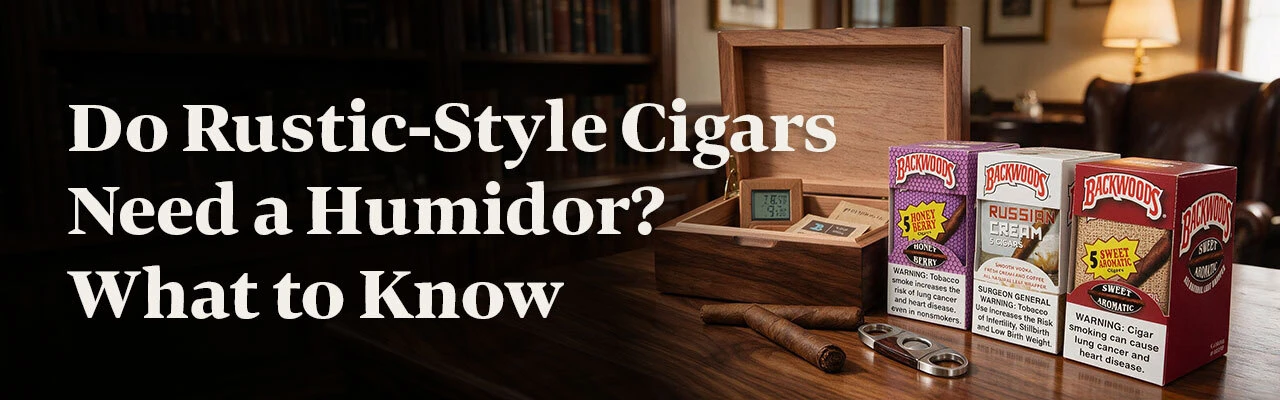
Because of their rugged appearance and natural leaf wrapper, many people assume Backwoods Cigars don't require the same level of care as traditional premium cigars. Their rustic construction often creates the impression that they can be stored just about anywhere without affecting quality. In reality, improper storage can cause Backwoods Cigars to dry out, lose their natural sweetness, develop an uneven burn, or become harsh long before you're ready to enjoy them.
Keeping Backwoods Cigars fresh doesn't require an elaborate setup, but it does require the right environment. Proper humidity, temperature, and storage methods help preserve the wrapper's moisture, maintain the cigar's flavor, and ensure a smoother, more consistent smoking experience. Whether you buy a single pack or keep several on hand for outdoor adventures, a little care goes a long way toward protecting your investment.
In this guide, we'll explain the best ways to store Backwoods Cigars, including ideal humidity and temperature ranges, practical storage solutions, and the warning signs that a cigar has become too dry or damaged. By the end, you'll know how to keep your Backwoods fresh and ready to smoke whenever the occasion calls for one.
Key Takeaways
- Learn why natural leaf cigars require specific moisture levels to preserve the essential oils that define their rugged flavor profile.
- Identify the updated environmental standards for temperature and humidity to prevent common issues like tobacco beetles or harsh draws.
- Evaluate the technical differences between traditional wood and modern acrylic solutions for optimal rustic cigars, cigar storage, and humidor maintenance.
- Understand the essential steps for seasoning and calibrating your equipment to ensure a perfect environment for your collection.
- Discover how professional-grade logistics and climate-controlled warehousing protect the integrity of your cigars from the factory to your door.
Understanding Rustic Cigars and the Essential Need for Freshness
Rustic cigars are prized far beyond their rugged, handmade aesthetic. Featuring whole, unrefined natural leaf wrappers, these sticks serve as rich reservoirs for organic essential oils, resins, and complex surface textures. While their unpolished appearance gives the impression of durability, natural leaf cigars are remarkably delicate and highly sensitive to environmental fluctuations.
Without rigorous moisture control, these vital oils rapidly evaporate, leaving you with a smoke that is flat, acrid, and structurally compromised. Categorizing these as casual cigars shouldn't imply they are disposable. If you have ever experienced a wrapper leaf that unravels or shatters the moment you cut it, you have witnessed the direct consequences of improper storage and moisture loss.
Anatomy of Natural Leaf vs. Homogenized Tobacco Leaf (HTL)
Understanding why natural leaf tobacco demands careful storage starts with its structural anatomy:
- Homogenized Tobacco Leaf (HTL): Used in high-volume, automated cigar production, HTL is an engineered sheet manufactured by pulverizing tobacco scraps into a fine powder and binding it with cellulose adhesives. Treated with synthetic humectants like propylene glycol, HTL maintains artificial softness and structural stability in ambient air, but lacks natural oil variance, aging potential, and flavor depth.
- Whole Natural Leaf Wrappers: In contrast, rustic cigars utilize whole, natural tobacco leaves. These leaves retain their natural cell walls and organic oil glands, making them hyper-reactive to ambient relative humidity. They absorb and release moisture dynamically, expanding and contracting based on surrounding air conditions.
The Volatile Oil Depletion Law: Rehydration Myth
A common misconception among enthusiasts is that a dried-out cigar can be completely restored to its original glory simply by placing it back in a humidor.
The Reality of Volatile Loss:
Re-humidifying a dehydrated natural leaf restores water weight and physical elasticity to cellulose fibers—it cannot replace lost volatile essential oils and terpenes. Volatile aromatic compounds like solanone and beta-damascenone, which grant Broadleaf, Maduro, and Cameroon leaves their signature notes of dark cocoa, leather, and sweet cedar, evaporate permanently when stored below 55% Relative Humidity (RH). Once lost to dry air, no amount of moisture will bring back those original flavor characteristics; the leaf becomes flexible again, but the taste remains papery and muted.
Combustion Physics: Vaporization vs. High-Heat Pyrolysis
Moisture level directly dictates the chemical reaction occurring at the glowing cherry of your cigar:
62%-65% RH Moisture ---> 700°C - 800°C Burn ---> Smooth Vaporization of Oils & Sugars
50% RH Dry Tobacco ---> 900°C+ Excess Heat ---> Pyrolysis (Acrid Tars & Ammonia Spike)
- Optimal Moisture Vaporization (62%–65% RH): When smoked at ideal internal humidity, the burn line operates at approximately 700°C to 800°C. At this temperature, thermal energy smoothly vaporizes volatile oils and caramelizes natural leaf sugars, producing a rich, aromatic smoke.
- Dry Tobacco Pyrolysis (<50% RH): When leaf moisture drops below 50% RH, combustion temperatures spike rapidly to over 900°C. Excess heat causes pyrolysis—the thermal decomposition of organic matter—burning off natural sugars before they can caramelize. This extreme temperature incinerates leaf cellulose into harsh carbon compounds, releasing acrid tars, free ammonia, and bitter bite on the palate.
Cellular Rupture and Vein Structural Damage
Rapid moisture loss degrades the physical structure of natural leaf tobacco from the inside out:
- Uneven Contraction Rates: Thick vein structures in Broadleaf or Cameroon wrappers hold internal moisture significantly longer than the thin leaf lamina running between them.
- Micro-Fractures: As dry air strips moisture from the thin leaf walls, the differential in contraction speeds creates micro-fractures along the main leaf veins.
- Wrapper Failure: When a cutter is applied to a dry cap, or when heat expands the internal filler during lighting, these micro-fractures split open longitudinally, causing the wrapper to peel back or shatter entirely.
Protecting Freshness from Warehouse to Humidor
Achieving a flawless draw and smooth flavor profile requires an uncompromised supply chain. Whether storing a boutique handmade blend or a casual natural leaf favorite, maintaining a stable environment prevents structural damage and oil depletion.
At Gotham Cigars, every stick is housed in a state-of-the-art, climate-controlled warehouse managed at precise moisture thresholds. This guarantees that your cigars arrive at your door with their natural essential oils, wrapper integrity, and flavor potential fully intact, ready for immediate enjoyment or seamless transition into your home humidor setup.
Optimal Environmental Conditions for Moisture Control
Environmental stability is the single most critical factor in long-term cigar preservation. While humidity and temperature fluctuations might seem minor, natural leaf tobacco expands and contracts dynamically in response to ambient shifts. This constant physical stress weakens wrapper fibers, leading to split seams, unravelling caps, and ruined smoke sessions. Maintaining precise environmental control preserves the essential oils and structural integrity of your collection.
Debunking the "70/70 Rule" for Heavy Natural Leaves
For decades, the traditional standard for cigar storage was the "70/70 rule"—70% Relative Humidity (RH) at 70°F. However, modern research and field testing show that this baseline is outdated, particularly for thick, oil-dense natural leaf wrappers such as Connecticut Broadleaf, Mexican San Andrés, and Maduro.
- Over-Saturation Risks: Thick natural wrappers absorb moisture with high efficiency. Storing them at 70% to 72% RH saturates the filler core, causing dense draw resistance, sour-tasting combustion, and tunneling (a burn defect where the dry internal filler burns away while the overly damp outer wrapper snuffs out).
- The Modern Standard: To ensure crisp combustion, an effortless draw, and stable burn lines, the modern industry target for natural leaf storage is 62% to 65% RH.
Psychrometrics, Water Activity, and Mold Growth
Airflow and relative humidity are inextricably linked to psychrometrics—the physical and thermodynamic properties of gas-vapor mixtures. At a constant moisture level, dropping ambient room temperature causes the relative humidity inside a sealed container to spike rapidly.
In cigar storage, mold spore germination is not dictated by humidity alone, but by Water Activity, which measures the amount of unbound, free water molecules available within the leaf matrix:
When relative humidity exceeds 72% RH at temperatures above 68°F (20°C), internal water activity crosses the critical 0.72 threshold. This triggers dormant fungal spores—primarily Aspergillus and Penicillium species—to germinate on organic natural leaf wrappers within 48 to 72 hours.
Preventing Stagnant Microclimates:
Stagnant air inside sealed humidors creates localized pockets of high water activity. Rotating your cigars every few weeks breaks up these microclimates and ensures even moisture distribution across all sticks.
Temperature Management and Tobacco Beetle (Lasioderma serricorne) Risk
Temperature control is just as vital as humidity management. While extreme cold (below 60°F) slows leaf aging and causes tobacco to enter a dormant state that mutes flavor development, high heat introduces a severe bio-hazard: the tobacco beetle (Lasioderma serricorne).
Dormant beetle eggs present in natural leaf tobacco begin hatching when internal humidor temperatures exceed 70°F to 72°F (21°C–22°C) in environments above 68% RH. Once hatched, microscopic larvae tunnel aggressively through tobacco leaf cores, destroying entire collections in days.
| Temperature Range Dynamics | |
| 60°F ---> | Leaf Dormancy (Maturation & Aging Slows) |
| 65°F - 68°F ---> | Optimal Maturation & Storage Target |
| 70°F+ ---> | Tobacco Beetle Egg Hatch Risk Active |
To eliminate the risk of pest activation, store your humidors in a cool, dark location away from direct sunlight, exterior windows, and heat-generating appliances (such as computers or refrigerators). Maintaining your storage setup strictly between 65°F and 68°F keeps beetle larvae dormant while allowing natural aging to proceed smoothly.
Starting your collection with inventory that has been kept at these exact parameters eliminates environmental stress from day one. Every stick shipped from Gotham Cigars is stored in a climate-controlled warehouse managed at professional baseline levels, protecting your investment from fulfillment to final burn.
Comparing Cigar Storage Solutions for Casual and Premium Sticks
Selecting the right storage hardware acts as a vital barrier against external environmental shifts. While whole natural leaf cigars possess organic resilience, unconditioned air can deplete their essential oils in hours. Whether you are storing everyday casual options or high-end premium vitolas, choosing appropriate storage hardware protects both the physical structure and flavor profile of your investment.
Traditional Cedar Humidors vs. Modern Acrylic & Tupperdors
| Spanish Cedar Humidor ---> | Porous Wood Buffer ---> | Natural VOCs (Cedrene/Cedrol) ---> | Traditional Aging |
| Acrylic / Tupperdor ---> | Zero Vapor Leakage ---> | 100% Moisture Trapped ---> | Low-Maintenance |
1. Spanish Cedar (Cedrela odorata): Biochemical Protection.
Spanish cedar remains the industry benchmark for traditional wooden humidors due to its distinct biochemical properties:
Spanish cedar remains the industry benchmark for traditional wooden humidors due to its distinct biochemical properties:
- Hygroscopic Buffering: Cedar features an open cellular structure that acts as an organic moisture sponge. It absorbs excess atmospheric humidity during damp spikes and releases water vapor when the ambient air dries out.
- Natural Resin Defense: Spanish cedar wood exudes volatile organic compounds (VOCs)—specifically cedrene and cedrol. These natural aromatic compounds act as biological repellents against tobacco beetles (Lasioderma serricorne) while actively inhibiting the growth of fungal surface mold.
- Aromatic Synergy: The gentle cedar aroma complements the dark earth, leather, and wood notes inherent in rustic Broadleaf and Maduro leaves.
2. Acrylic Humidors & Plastic "Tupperdors"
Modern acrylic humidors and gasketed plastic containers offer exceptional low-maintenance alternative storage. Unlike porous wood, acrylic and plastic feature zero vapor permeability, trapping 100% of internal moisture.
CRITICAL CALIBRATION NOTE — The Tupperdor RH Offset
Because airtight plastic and acrylic containers lose no water vapor to the outside air, two-way humidification packs (such as Boveda) routinely perform 2% to 4% higher than their printed rating. For example, placing a 69% RH pack inside an airtight Tupperdor will maintain an internal equilibrium of 71% to 73% RH—a level that risks tight draws and mold growth. To achieve the optimal target of 65% RH in an acrylic or Tupperdor setup, always utilize 62% RH packs.
Short-Term Storage Hacks and On-the-Go Freshness
You do not need a massive wooden humidor to protect your cigars during short trips or outdoor events. Specialized travel hardware and temporary hacks provide effective protection when utilized correctly:
- Heavy-Duty Sealed Bags: A thick freezer bag paired with a small 62% two-way humidification pack can maintain stable moisture levels for 24 to 48 hours.
- Protective Cigar Tubes: Individual metal or plastic tubes shield delicate natural wrappers from physical friction, preventing cap cracking while carried in pockets or travel bags.
- Plastic Tupperdors: An airtight food-storage container featuring locking side latches and a rubber gasket is the most cost-effective solution for storing medium-to-large collections with near-zero maintenance.
The Refrigerator Moisture Deficit Danger
STORAGE WARNING — Domestic Refrigerators
Placing cigars inside a home refrigerator rapidly dehydrates tobacco. Modern frost-free refrigerators rely on continuous cooling cycles driven by evaporator coils that strip water vapor directly from the air, driving internal relative humidity below 30% RH.
Furthermore, cold temperatures alter natural leaf lipids and create an extreme vapor pressure differential between the core tobacco and the surrounding cold air. This differential leeches moisture out of the leaf matrix within hours, rendering the wrapper brittle and permanently muting its essential oils.
Stick to dedicated, room-temperature storage solutions to keep your cigars in prime smoking condition. Every order fulfilled by Gotham Cigars is picked directly from our climate-stabilized warehouse, ensuring your stock arrives fresh and ready for immediate placement into your home storage system.
Cigar Care: Routine Maintenance and Freshness Restoration
Maintaining cigar freshness is a precise, technical process. Even resilient natural leaf and casual cigars rapidly degrade if neglected in stagnant, unmonitored environments. Proper humidor maintenance extends far beyond glancing at an external dial; it requires accurate diagnostic tools, proper seasoning techniques, and proactive stock rotation.
Routine Diagnostics and Calibration Precision
To keep your storage environment stable, prioritize tool accuracy and regular maintenance:
- Digital vs. Analog Gauges: Analog spring hygrometers are notoriously unreliable, frequently misreading relative humidity by as much as 10%. This error often leads to unintentional over-humidification, sour combustion, and mold growth. Always utilize digital hygrometers with sensor accuracy.
- Hygrometer Calibration Standard: While traditional DIY salt tests (mixing table salt and water in a cap) are common, minor variations in wetness lead to significant calibration errors. For true lab-grade precision, calibrate digital hygrometers using a pre-formulated 75% RH calibration kit, which provides an exact reference point within 0.3% accuracy.
- 3-Week Stock Rotation: Rotate your cigars every three weeks. Moving bottom-tier sticks to the top ensures even exposure to your humidification source and prevents localized moisture pockets from forming inside the container.
Seasoning Spanish Cedar Without Structural Damage
Seasoning a new wooden humidor prepares the Spanish cedar to buffer internal humidity. Rushing this process damages the hardware and compromises environmental control.
CRITICAL CARE WARNING — Never Sponge Cedar Directly
Never wipe raw Spanish cedar boards directly with a damp sponge or cloth. Direct contact with liquid water causes raw wood fibers to swell rapidly and unevenly, causing internal planks to warp and permanently ruining the humidor's lip seal.
- Passive Water Vapor Saturation: Place a small container of pure distilled water or dedicated 84% RH seasoning packs inside the closed, empty humidor.
- Eliminate Mineral Contamination: Use only distilled water or pre-mixed 84% seasoning solutions. Tap water and spring water contain dissolved minerals that leave white crusts on cedar wood and introduce active mold spores.
- Stabilization Window: Allow the wood to passively absorb water vapor until the internal relative humidity stabilizes between 65% and 68% for at least 48 to 72 hours before introducing your natural leaf cigars.
Debunking the "Plume / Bloom" Myth
For decades, smokers believed that a fine white powder appearing on wrapper leaves was "plume" or "bloom"—supposedly crystallized essential oils indicating a perfectly aged cigar. Laboratory testing has conclusively proven that this is a myth.
[White Surface Residue]
├── Microscopic Fungal Hyphae / Fuzz ---> MOLD (Isolate / Wipe Clean)
└── Crystalline Mineral Salts ---> EFFLORESCENCE (Safe to Wipe & Smoke)
└── "Crystallized Essential Oils" ---> SCIENTIFIC MYTH (Does Not Exist)
Essential tobacco oils do not dry into a white crystalline dust on wrapper leaves. Any white, dusty, or thread-like growth on a wrapper is either:
- Surface Mold (Aspergillus species): Fungal growth triggered by relative humidity exceeding 72% RH or stagnant microclimates. If detected on the wrapper, wipe the stick clean with a dry cloth and immediately isolate it from the rest of your collection. If mold is present on the foot (filler core), discard the cigar entirely.
- Efflorescence: Inorganic mineral salts leached out of soil and tobacco fibers that deposit on the surface. These can be brushed off cleanly without affecting smoke quality.
Staged Re-Humidification Protocol (Restoring Dry Cigars)
If a natural leaf cigar dries out, you can often restore its physical elasticity—provided the wrapper remains intact. However, re-humidification must be managed slowly. If dry filler tobacco absorbs water too quickly, it expands faster than the brittle wrapper leaf, snapping the outer leaf longitudinally.
Follow this 6-to-8-week staged re-humidification protocol to avoid "leaf shock":
- Stage 1 (Weeks 1–2): Place dehydrated cigars in a sealed container with a 58% to 62% RH pack. This slowly re-introduces baseline water vapor to outer cellulose fibers without forcing rapid filler core expansion.
- Stage 2 (Weeks 3–4): Maintain the environment strictly at 62% RH, allowing moisture to penetrate evenly into the inner binder and filler bunching.
- Stage 3 (Weeks 5–8): Cap final equilibrium at 62% to 65% RH.
Do not push restoration humidity to 69% RH or higher. Capping restoration at 62%–65% RH prevents over-saturation, preserves remaining volatile leaf resins, and restores the stick to peak smoking readiness.
To avoid the tedious process of reviving neglected inventory, consider subscribing to the Gotham Cigars Cigar of the Month Club to maintain a continuous rotation of climate-stabilized cigars delivered directly to your door.
Sourcing and Protecting Your Collection with Gotham Cigars
The long-term performance and flavor integrity of your personal cigar collection depend heavily on how tobacco is handled before it arrives at your door. Operating out of Florida since 2001, Gotham Cigars maintains a specialized, climate-controlled facility engineered specifically to preserve cigar freshness at strict professional standards.
Whether fulfilling an order for a single Arturo Fuente vitola or a bulk shipment of Swisher Sweets, maintaining a strictly monitored environmental chain ensures every stick arrives in prime condition.
Warehouse Microclimate Control: Overcoming Florida’s Climate Challenges
Florida’s native outdoor climate presents severe challenges for tobacco preservation, with ambient relative humidity routinely surging past 80% alongside elevated temperatures.
To counteract these aggressive external conditions, professional warehouse operations utilize industrial HVAC systems, commercial-grade dehumidification, and continuous electronic monitoring to stabilize indoor storage parameters:
- Target Microclimate: Indoor storage zones are held strictly at 65°F to 68°F and 62% to 65% RH.
- Preventing Physical Damage: Maintaining this precise moisture equilibrium prevents cellular leaf expansion, wrapper seam popping, and thermal shock during fulfillment.
- Biological Suppression: Keeping temperatures below 68°F suppresses fungal spore germination and ensures dormant tobacco beetle larvae (Lasioderma serricorne) remain completely inactive.
Physical Zone Isolation Protocols
Storing infused or aromatic products in the same warehouse racking as natural leaf cigars leads to severe cross-contamination. Volatile essential oils and botanicals used in infused cigars continuously off-gas into surrounding air, where porous natural leaves rapidly absorb them.
To protect inventory integrity, storage racking is divided into three physically segregated isolation zones supported by separate air-handling units:
[Warehouse Racking Isolation Zone A] ---> Premium Natural Long-Filler (Isolated HVAC)
[Warehouse Racking Isolation Zone B] ---> Infused / Botanical Flavored (Dedicated Barrier)
[Warehouse Racking Isolation Zone C] ---> Pouch-Sealed Machine-Made (Ambient Sealed)
- Zone A (Premium Natural Long-Filler): Houses traditional natural cigars (such as Arturo Fuente, Montecristo, and AJ Fernandez) under isolated HVAC systems to guarantee zero aroma migration.
- Zone B (Infused & Botanical Flavored): Segregates aromatic inventory (such as Acid Kuba Kuba and Tatiana Flavored Cigars) behind physical vapor barriers, preserving their distinct essential oils without contaminating surrounding stock.
- Zone C (Pouch-Sealed Machine-Made): Manages foil-pouched natural leaf and HTL products (such as Backwoods Honey Berry and Swisher Sweets) in sealed ambient conditions to protect their factory-applied humectants.
Transit Shielding and Thermal Buffer Packaging
During shipping, parcels encounter unconditioned postal transport vehicles and distribution hubs where internal temperatures can exceed 110°F (43°C) in warmer months. Unprotected tobacco exposed to this level of heat quickly dries out, losing vital wrapper oils and experiencing internal moisture pressure shifts.
To insulate cigars against severe transit environments:
- Orders are sealed in vapor-barrier poly packaging to block external moisture loss.
- Enclosed two-way humidification packs maintain a stable internal microclimate throughout shipping.
- This thermal and humidity buffering prevents transit shock, ensuring sticks arrive ready for immediate smoking or effortless integration into your home humidor.
The Gotham Quality Assurance & Rotation Advantage
Building a well-rounded collection requires balancing high-end specialty sticks with reliable daily smokes. You might reserve a Montecristo White Series for special occasions while keeping Dutch Masters President or Backwoods on hand for quick outdoor breaks. Curated bundles and direct manufacturer partnerships allow you to explore diverse flavor profiles without over-investing in a single line.
- Direct Brand Partnerships: Authorized retail partnerships with top manufacturers—including Acid, Arturo Fuente, Swisher Sweets, and Romeo y Julieta—ensure factory-direct authenticity.
- Cigar of the Month Club: A subscription model that delivers fresh, hand-selected inventory directly to your door, allowing you to discover new fermentation styles and vitolas without managing aged retail stock.
- Global Accessibility & Support: Comprehensive shipping options and expert customer support assist you in selecting the right products and storage hardware for your climate.
Secure the Future of Your Flavor Profile
Mastering the technical nuances of moisture and temperature control is the absolute boundary between a harsh, bitter burn and a smooth, aromatic session. Whether you manage a traditional Spanish cedar cabinet or an airtight Tupperdor, maintaining a stable microclimate guarantees that your natural leaf wrappers remain pliable, intact, and saturated with essential flavor resins. Consistency is the cornerstone of every exceptional smoke.
Quick-Reference Blueprint: Storage & Moisture Control Matrix
Use this reference guide to match your specific tobacco inventory to its exact relative humidity target, temperature parameter, and ideal storage setup:
| Cigar Category / Leaf Type | Target Relative Humidity (RH) | Target Temperature | Primary Storage Container | Humidification Source |
|---|---|---|---|---|
| Premium Natural (Broadleaf / Maduro) | 62%–65% RH | 65°F–68°F | Spanish Cedar Humidor or Tupperdor | 62% or 65% Boveda Packs |
| Infused / Botanical (e.g., Acid) | 65%–68% RH | 65°F–68°F | Isolated Tupperdor (Separate from Natural) | 65% Boveda Packs |
| Pouch Machine-Made (e.g., Backwoods) | Ambient Factory Pouch Seal | 65°F–72°F | Factory-Sealed Foil Pouch (No Humidor) | Internal Factory Humectants |
| Long-Term Aging Stock (Natural Leaf) | 65%–68% RH | 63°F–65°F | Spanish Cedar Cabinet or Cabinet Humidor | Electronic Humidifier / 65% Boveda |
Short-Term Smoking Readiness vs. Long-Term Aging Dynamics
Optimizing your storage strategy requires understanding the functional difference between immediate smoking condition and long-term aging:
- Short-Term Smoking Readiness (62%–65% RH): Maintaining tobacco at a lower moisture baseline keeps internal draw channels open and free-flowing. Lower moisture prevents over-saturation of the core filler, ensuring crisp wrapper combustion, preventing sour-tasting burn line defects, and delivering immediate flavor clarity upon lighting.
- Long-Term Aging Environment (65%–68% RH): For long-term maturation, a slightly higher humidity level combined with cooler temperatures (63°F–65°F) slows down organic leaf degradation. This stable microclimate allows volatile tannins and residual ammonia compounds to break down gracefully over months and years without drying out the essential oils embedded in the wrapper leaf.
Upgrade Your Collection with Gotham Cigars
With over 20 years of specialized industry experience, Gotham Cigars applies rigorous logistics standards to every shipment. Every item in our inventory is housed in a state-of-the-art, climate-controlled warehouse in Florida, guaranteeing that your stock is protected against environmental stress long before it reaches your door.
As a direct authorized retailer for premier brands—including Arturo Fuente, Acid, Montecristo, and Romeo y Julieta—we provide the quality assurance you need for a pristine draw and an uncompromised burn every time.
Explore our extensive selection of fresh, climate-stabilized cigars and premium humidor accessories at Gotham Cigars today, and secure the true potential of your collection.
Frequently Asked Questions
Do rustic or machine-made cigars really need a humidor?
Yes, any cigar using a natural leaf wrapper requires a humidor to maintain its structural integrity and flavor. While machine-made options are often perceived as indestructible, the tobacco leaves still contain essential oils that evaporate in dry air. Storing these in a controlled environment prevents the wrapper from cracking and ensures the flavor remains smooth rather than acrid. Even short-term exposure to low humidity can ruin the intended experience of your favorite daily smoke.
How long can I leave a cigar out of the humidor before it goes bad?
Most cigars will stay fresh for roughly two to three days outside of a humidor before they begin to degrade physically. In environments with heavy air conditioning or heating, this window shrinks significantly as the dry air strips moisture from the tobacco. Once the leaves lose their natural oils, the cigar burns faster and hotter, resulting in a bitter taste. If you're traveling, always use a sealed bag or travel case to protect your inventory.
What is the best humidity level for natural leaf cigars like Backwoods?
Maintain a relative humidity between 62% and 65% for natural leaf products to ensure the best burn and draw. This range is slightly lower than the old industry standard but is ideal for Rustic Cigars because it prevents them from becoming too soft. Higher humidity levels can make these cigars "spongy," which often leads to a tight draw or an uneven burn. Keeping the environment stable at these levels preserves the earthy, organic notes found in the leaf.
Can I store flavored cigars like Acid Kuba Kuba with my regular premium cigars?
No, you must store infused cigars in a separate humidor to prevent cross-contamination of flavors and aromas. The strong aromatic oils and botanicals used in the infusion process are highly volatile and will easily seep into your non-flavored cigars. This migration permanently ruins the flavor profile of your traditional premium sticks. A simple airtight plastic container with its own humidification source is an effective and affordable way to keep these collections isolated.
How can I tell if my cigar is too dry to smoke?
A dry cigar will feel brittle and make a distinct crackling sound when you gently press it between your fingers. If the wrapper feels like dry autumn leaves or shows visible cracks, it has lost its essential moisture. You might also notice that the cigar feels lighter than usual because the water weight has evaporated. Smoking a cigar in this condition leads to a hot, harsh draw that masks the tobacco's natural sweetness and complexity.
Why does my humidor keep losing humidity even after seasoning?
Humidity loss is usually caused by a poor lid seal or a dry cedar lining that is absorbing the moisture intended for your cigars. Perform the dollar bill test by closing the lid on a bill; if it slides out easily, your seal is compromised. Proper Humidor Maintenance also involves recalibrating your hygrometer every six months. If the wood was not seasoned correctly, it will continue to pull water from the air until the cedar fibers are fully saturated.
Is it better to use a digital or analog hygrometer for moisture control?
Digital hygrometers are the superior choice for accurate Moisture Control because they provide precise readings that analog versions cannot match. Analog gauges are notoriously unreliable and can be off by as much as 10% right out of the box. A digital sensor allows you to monitor small fluctuations in real-time, which is vital for protecting sensitive natural leaf wrappers. Always choose a model that allows for manual calibration to ensure long-term reliability and peace of mind.
What should I do if I find mold on my cigars?
Isolate the moldy cigars immediately and inspect the rest of your collection for signs of spreading spores. If the mold is white and confined to the wrapper, you can gently brush it off and smoke the cigar immediately. However, if you see green or blue fuzzy growth, or if mold is visible on the foot of the cigar, you must throw it away. Clean the humidor with distilled water and a light touch of isopropyl alcohol to kill any remaining bacteria.
Further Reading
- The Backwoods Experience: Rustic Style, Outdoor Culture, and Casual Smoking
- Why Backwoods Cigars Look Different From Traditional Cigars
- Backwoods and Outdoor Smoking Culture: Travel, Camping, and Social Moments
- Casual vs Formal Smoking: Where Backwoods Fits in the Cigar World
- Understanding the Rough-Cut Format and Natural Leaf Style
- Quick Break vs Long Session: How Backwoods Fits Different Smoking Moments
- Pairing a Rustic Cigar With Coffee, Beer, or Outdoor Settings
- The Story Behind Backwoods and Its Outdoor Identity
- Backwoods vs Traditional Cigars: What Makes the Smoking Experience Different
- Rough-Cut vs Smooth-Wrapped Cigars: Understanding the Backwoods Style
- Casual Outdoor Smoke vs Lounge Cigar Experience: Where Backwoods Fits
- Quick Break vs Long Session: Choosing the Right Rustic Cigar Moment
- Natural Leaf Appearance vs Traditional Uniform Cigars: What Changes in the Feel
- Backwoods FAQ: Expectations, Storage, and First Impressions
Recent Posts
-

Holiday Gift Guide for Cigar Lovers: Gifts for Every Type of Enthusiast
Finding the right holiday gift for a cigar lover doesn't have to mean choosing the most expensive b …13th Nov 2026 -

Cigar Review | Avo Cigars No.2 Cigar is One of the Best
I'm not a cigar expert, but I know when I get my hands on something good, and this weekend I defini …11th Nov 2026 -

Top Five Avo Cigars and a History of Avo
"I have always loved beautiful music. Then I found the cigar. A good cigar is like music. Now I hav …6th Nov 2026